

WhatsApp
+86 17331173621
E-mail
zhnylon@gmail.comViews: 0 Author: Site Editor Publish Time: 2025-04-16 Origin: Site


Cast nylon, also known as polyamide 6 (PA6), is a high-performance thermoplastic with a broad range of industrial applications. Among its many mechanical properties, one that engineers often consider is the Poisson’s ratio. This fundamental parameter plays a crucial role in understanding how materials behave under mechanical stress. In this article, we explore the Poisson’s ratio of cast nylon, why it matters, and how it affects component design and application.
Poisson’s ratio (ν) is a measure of the transverse strain to axial strain in a material subjected to uniaxial stress. In simple terms, when a material is stretched or compressed, it tends to contract or expand in the direction perpendicular to the force.
Mathematically:
ν=−Lateral StrainAxial Strain\nu = -\frac{\text{Lateral Strain}}{\text{Axial Strain}}ν=−Axial StrainLateral Strain
This ratio provides insight into how "rubbery" or "rigid" a material behaves during deformation.
The Poisson’s ratio of cast nylon typically ranges from 0.35 to 0.42, depending on temperature, moisture content, and test method. This value indicates that cast nylon exhibits moderate lateral contraction when stretched—common for semi-crystalline thermoplastics.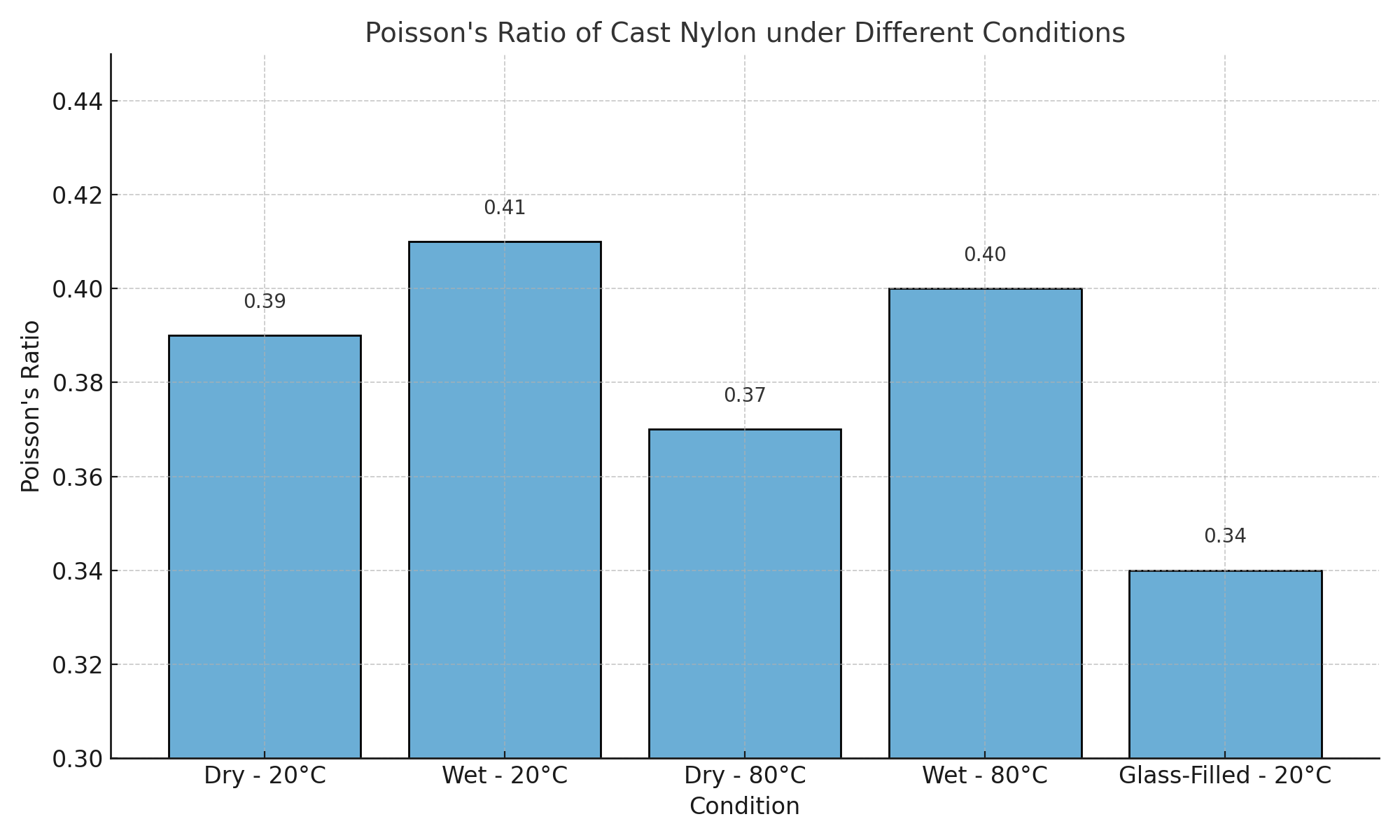
| Property | Value Range |
Poisson’s Ratio (ν) | 0.35 – 0.42 |
Young’s Modulus | ~2.8 GPa |
Tensile Strength | 75 – 90 MPa |
Elongation at Break | 30 – 60% |
Density | ~1.15 g/cm³ |
Understanding cast nylon’s Poisson’s ratio is essential in:
Finite Element Analysis (FEA): Accurate ν values improve simulation fidelity.
Component Design: Predicts dimensional changes under load.
Structural Stability: Assists in avoiding buckling or warping.
Multiaxial Loading: Ensures reliable mechanical response in dynamic systems.
For example, in bushings, gears, or wear pads, dimensional tolerance can be impacted by lateral expansion due to axial loads, which is directly influenced by Poisson’s ratio.
Moisture Absorption
Nylon 6 is hygroscopic. Higher moisture levels soften the material, often slightly reducing Poisson’s ratio.
Temperature
At elevated temperatures, the ratio may increase slightly due to reduced stiffness.
Filler Content
Glass-filled cast nylons may have lower Poisson’s ratios, often closer to 0.30–0.33, due to increased rigidity.
| Material | Poisson’s Ratio |
Cast Nylon 6 | 0.35 – 0.42 |
Steel | 0.27 – 0.30 |
Aluminum | 0.33 |
Rubber | 0.45 – 0.50 |
PTFE (Teflon) | 0.46 |
This comparison shows that cast nylon behaves softer than metals but stiffer than elastomers.
The Poisson’s ratio of cast nylon is a key mechanical property that affects deformation behavior, structural design, and performance under stress. With values ranging from 0.35 to 0.42, engineers can predict how cast nylon components will behave in real-world applications. Understanding this parameter, along with other material properties, enables better product design, especially in industries like automotive, aerospace, and heavy machinery.
If you're working with cast nylon materials or designing custom-engineered parts, factoring in Poisson’s ratio is crucial to success.